
Visiting
How long can I stay in Canada as a visitor?
Most visitors can stay for up to 6 months in Canada.
If you’re allowed to enter Canada, the border services officer may allow you to stay for less or more than 6 months.
- If that’s the case, they’ll put the date you need to leave by in your passport. They might also give you a document.
- If you don’t get a stamp in your passport, you can stay for 6 months from the day you entered Canada or until either your passport or biometrics expire, whichever comes first. Super visa holders who enter Canada after June 22, 2023 can stay for up to 5 years.
- If you need a stamp, you can ask a border services officer for one. If you arrive at an airport that uses primary inspection kiosks, you may ask the border services officer for a stamp after you finish at the kiosk.
If you want to stay longer than your authorized stay, you should apply for an extension at least 30 days before the authorized end of your stay.
Do I need to apply for both a visitor visa and an eTA?
No. If you plan to travel to Canada, you need a valid visitor visa OR a valid eTA.
The one you need depends on:
- the type of travel document you will travel with;
- the country that issued your travel document;
- your nationality; and
- how you will travel to Canada.
Before you apply, answer a few questions to find out what you need to travel to Canada.
If you already have a valid Canadian visitor visa you don’t need to apply for an eTA – even if you’re eligible for an eTA. You can travel with your visa until it expires.
If you apply for an initial work or study permit before you travel to Canada, you’ll get a visa or an eTA automatically once your work or study permit application is approved. You don’t need to apply for a visa or an eTA, or pay extra fees.
- If we issue you a visa, we’ll stick in your passport.
- If we issue you an eTA, your eTA number will be included in the letter of introduction we will send you when your study or work permit is approved. Keep this number in case you need to contact us about your eTA.
My application for a visitor visa was refused. Should I apply again?
Whether you should apply again depends on why your application was refused and whether your situation has changed.
Your refusal letter lists the reason(s) the officer refused your application. Applying again with the same information, even with an immigration representative, such as a consultant or agent, will likely not change this decision.
Your application may be refused for various reasons, including
- the officer wasn’t satisfied that you’d leave Canada by the end of your authorized stay
- you’re inadmissible to Canada
Hiring an immigration representative, consultant or agent
Hiring an immigration representative, such as a consultant or agent, doesn’t
- increase the chances of your application being approved, or
- change any previous decision made by an officer on your application
If anyone tells you you’ll have a better chance on your second application because they’re representing you, they’re not being truthful and are likely looking to take your money.
Learn how to choose an authorized representative and how to recognize common immigration scams.
If your situation changes
If your situation has changed since you initially applied, you can apply again if you have new information or documents to give that address the reason(s) why you were initially refused. These reasons are found in your refusal letter.
Even your situation changes, this does not guarantee that an IRCC officer will approve your application.
Examples of how your situation could change
Below is a list of some of the ways your situation could have changed that may lead to a different decision if you were to reapply.
- The purpose of your visit has changed.
- Your employment or financial situation has changed.
- you’ve applied for criminal rehabilitation and were approved.
- You were inadmissible for medical reasons, but those reasons have since changed.
If you believe the wrong decision was made on your application
If you believe the process was unfair, you may request a judicial review through the Federal Court of Canada.
I am currently living in or visiting a country that I am not a citizen of. Can I apply for a visitor visa at the local visa office?
If you are applying on paper we recommend that you apply for a visa from your home country. However, if you are legally admitted to the country you are currently in, you can apply at your nearest visa application centre (VAC). The VAC can help make sure your application is complete and that all proper documentation is included. You must state clearly on your application why you have not applied in your normal country of residence.
You can also apply for a visa online.
What’s the difference between a visitor visa and a visitor record?
A visitor visa (also known as a temporary resident visa) is an official document citizens from visa-required countries need to get to travel to and enter Canada as a visitor for up to 6 months.
- We stick the visitor visa in your passport.
- It shows that you meet the requirements to enter Canada.
- It includes the date by which you must arrive in Canada.
- The date is not an expiry date for your stay in Canada.
- If you apply for a study or work permit for the first time, you’ll automatically get a visitor visa when we approve your application.
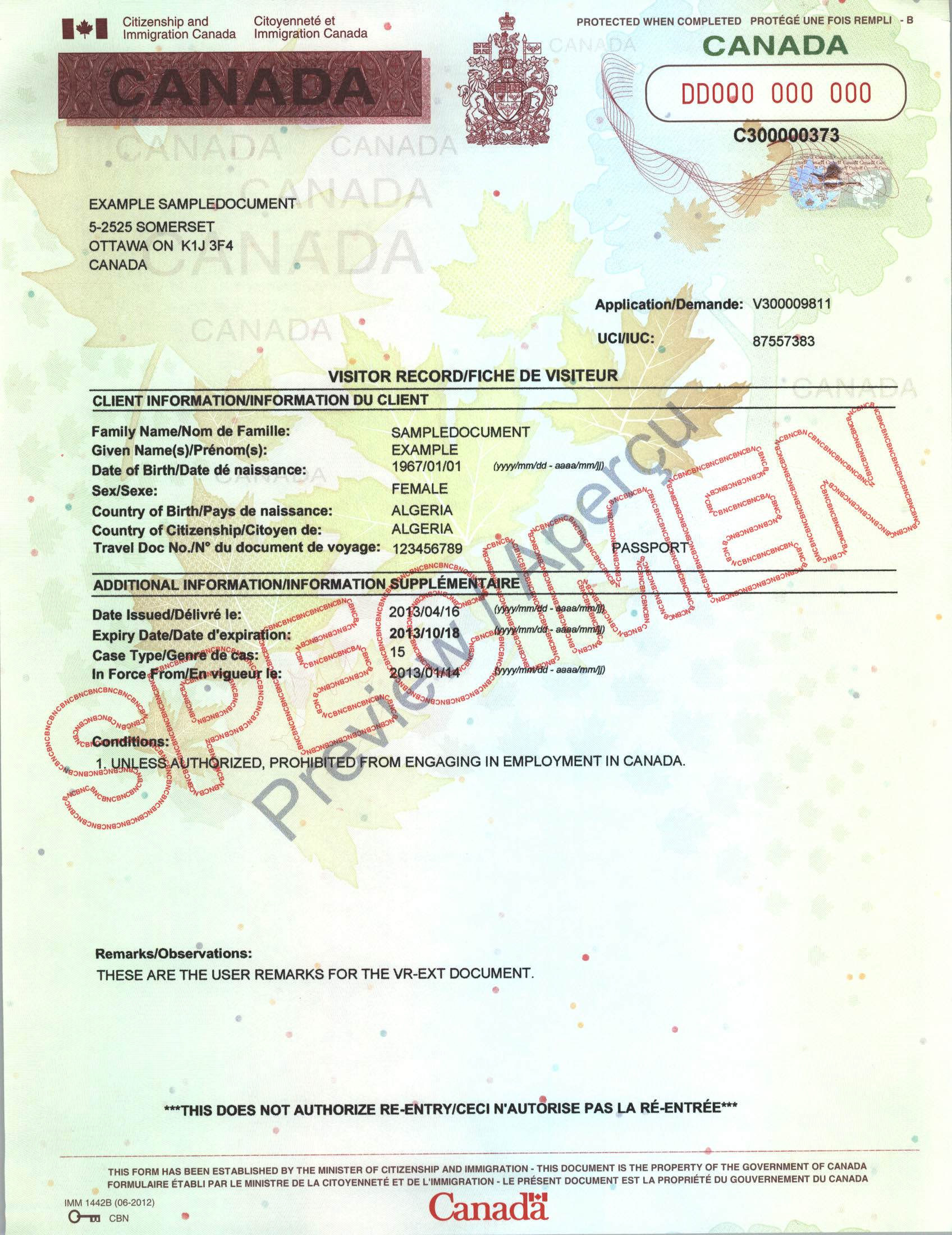
A visitor record is a document that a border services officer may issue to you to extend or restrict your stay in Canada. If you want to stay in Canada for more than 6 months, you have to tell the border services officer.
You may also get a visitor record after we approve your application to extend your stay or restore your status. A visitor record is issued either by the Canada Border Services Agency or Immigration, Refugees and Citizenship Canada.
- You need to apply for a visitor record when:
- you first arrive at the port of entry and you know you want to stay longer than 6 months; or
- you’re in Canada and decide you want to stay longer.
- You must apply at least 30 days before your authorized stay in Canada expires.
- It’s an independent document (not placed in your passport).
- It includes an expiry date for your stay in Canada.
- That’s the date by which you must leave Canada.
Image of a visitor visa
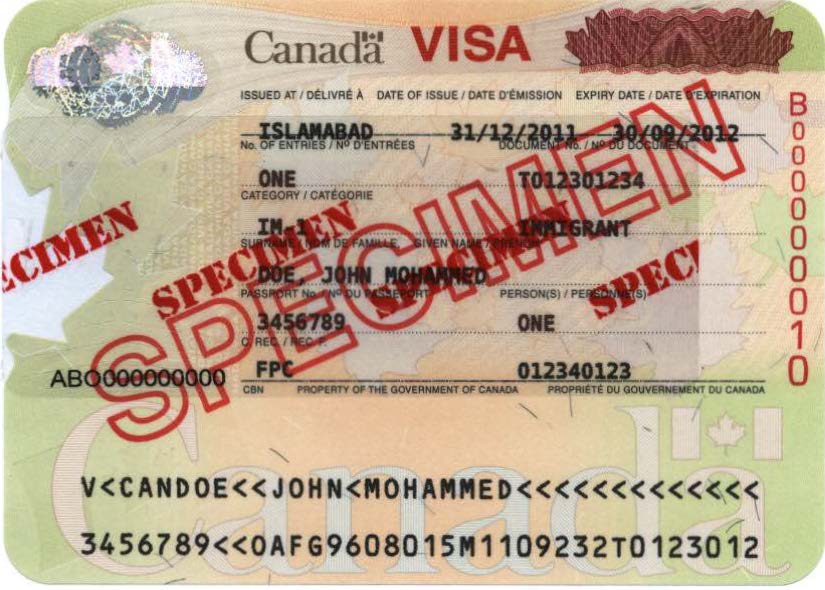
Image of a visitor record
My application for a permanent resident visa is currently being processed at the Embassy. Can I go to Canada as a tourist and wait for my visa there?
You may travel to Canada as a tourist before you get your permanent resident visa. However, we strongly advise against making any definitive arrangements for your stay in Canada until you have received your permanent resident visa.
You will need to apply for a visitor visa to travel to Canada as a tourist.
Please note that having a valid visitor visa does not guarantee your entry into Canada. A border services officer will decide if you can enter Canada and how long you can stay.
I hold a diplomatic or special/service passport. Do I need a visitor visa?
Holders of diplomatic, official and service passports from visa-required countries do need a visa to visit Canada. However, they may be exempt from paying the processing fee if they are travelling on official business.
Do I need a Canadian visa if I have a United States visa?
Yes, most travellers need a visitor visa or an eTA to travel to, or transit through, Canada.
What you need depends on:
- the type of travel document you will travel with;
- the country that issued your travel document;
- your nationality; and
- how you will travel to Canada.
Before you apply, find out what you need.
I now need an immigration medical exam (IME) to visit Canada. Does this affect my submitted application?
People who apply to come to Canada temporarily and who lived in a country/territory with a high tuberculosis rate need an IME with their application. We use data from the World Health Organization to calculate the tuberculosis rate.
As of November 23, 2017, if you lived in Singapore, Tunisia or Fiji for most of the past year (6 months or more), you must complete an IME when you apply to come to Canada for six months or more.
If you lived in the following countries, you no longer have to complete an IME, unless we contact you and ask for one:
- Argentina
- Bahrain
- Belize
- Colombia
- Portugal
- the Seychelles
- Surinam
- Venezuela
If you already submitted an application before this change:
- you won’t be penalized if you followed the guidelines that existed at the time we received your application, however,
- you have to get an IME if we asked you for one.
Find out who must complete the Immigration Medical Exam.
I got a new passport but I have a valid visa in my old one. Can I use the visa in my old passport?
Yes. To travel to Canada using a valid visa in an old passport, you need to bring both
- your old passport with the valid visa
- You may need to explain why your old passport isn’t valid.
- your new valid passport or travel document
Even though you can use a valid visa in an old passport, we recommend that you get a new visa in your valid passport to avoid delays at the border.
Do I need a visa to visit Canada?
Most travellers need a visa or an Electronic Travel Authorization (eTA) to fly to, or transit through, a Canadian airport.
What you need depends on:
- the type of travel document you will travel with;
- the country that issued your travel document;
- your nationality; and
- how you will travel to Canada.
If you do not have the proper documents, such as an eTA or visa, you may be delayed or prevented from boarding your flight to Canada.
Before you apply, find out what you need to travel to Canada.
What is the difference between a single-entry and a multiple-entry visa?
The main difference between these two visa types is that a single-entry visa allows entry to Canada for one-time only and a multiple-entry visa allows entry many times before the expiry date.
Which type of visa to get
You don’t need to choose. We will review your application and issue you a visa depending on your situation.
Multiple-entry visa
While valid, a multiple-entry visa will let you travel to Canada as many times as you want. It will be valid for up to a maximum of 10 years or until the expiry date of either your passport or biometrics, whichever comes first. An officer may set a different expiry date, depending on your circumstances.
You must arrive in Canada on or before the expiry date on your visa.
Single-entry visa
A single entry visa lets you travel to Canada only one time. You may receive a single-entry visa if:
- you’re eligible for a fee-exemption and the purpose of your entry to Canada is limited (such as, for an official visit by a foreign national);
- you’re coming for a one-time special event, celebration or tour in Canada;
- you’re coming for short term studies (less than 6 months) or short term work and don’t need a study or work permit; or
- there are approved country-specific procedures or guidelines in place.
In most cases, once you have left Canada, you will need a new visa to enter Canada again.
You won’t need a new visa if you’re
- only travelling to the United States (including its Territories and Possessions) or St. Pierre and Miquelon, and
- returning directly to Canada.
Why was I issued a single entry visa instead of a multiple entry visa?
All applicants who are eligible for a multiple entry visa will be issued one. However, not all applicants will be eligible for a multiple entry visa. This remains at the discretion of a visa officer. A single entry visa may be issued in cases where, for example:
- An applicant is eligible for a fee-exemption and where the purpose of entry to Canada is limited (e.g., for an official visit by a foreign national);
- An applicant is participating in a one-time special event in Canada (e.g., Pan-American Games); and/or
- Country-specific procedures or guidelines are in place and approved by IRCC.
I have an eTA or a visa. What can I expect when I arrive in Canada?
When you arrive at the point of entry in Canada, a border services officer will make sure you meet the requirements to enter Canada.
The officer will authorize your stay by stamping your passport and/or issuing another document.
If there is no stamp, handwritten date or document in your passport, your temporary resident status will expire six months from the day you arrived in Canada.
If you received a visitor record, student or work permit, the expiry date is marked on it.
I am in Canada on a temporary resident visa. I plan to take a cruise. Do I need a new visa to come back to Canada?
If you are on a cruise ship that departs from Canada or the continental United States and enters international waters and you are not in possession of a valid multiple-entry visa, you will need to obtain a new temporary resident visa in order to re-enter Canada.
Do I need a visa if I’m just travelling through Canada on my way to another country?
The document you need to transit through Canada depends on a few factors, including if you plan to visit Canada.
You can answer a few questions to find the document you need to transit through Canada.
Visa-required travellers
You’re considered a visa-required traveller if you’re from a visa-required country.
You need a visitor visa if:
- you visit Canada (even if you’re travelling by air and it’s for less than 48 hours)
- stay in Canada more than 48 hours while transiting, or
- you’re crossing the border by:
- bus
- car
- train
- boat
- cruise ship
You need a transit visa if:
- your international flight stops at a Canadian airport on its way to another country
- you’ll be connecting between 2 international flights at a Canadian airport
- you’ll transit through Canada in 48 hours or less, and
- you don’t have a valid visitor visa
Visa-exempt travellers
You’re considered a visa-exempt traveller if you’re from an eTA-required country.
You need an eTA to transit through Canada by air if you’re from an eTA-required country.
You don’t need an eTA if you’re transiting through Canada and you enter by train, bus, boat or cruise ship. You do need to bring the right travel documents.
How do I get a transit visa?
You can apply for a transit visa by filling out the application for a Temporary Resident Visa and selecting transit visa from the list of options on the form.
You may not need a transit visa if you are travelling to or from the United States. The Transit Without Visa program (TWOV) and the China Transit Program (CTP) allow certain foreign nationals to transit through Canada on their way to and from the United States without a Canadian transit visa, if they meet certain requirements.
How do I help a family member or friend apply to visit Canada?
Anyone who plans to visit Canada must apply from outside of Canada before they travel.
What your friend or family member needs depends on:
- the type of travel document they will travel with;
- the country that issued their travel document;
- their nationality; and
- how they will travel to Canada.
Before applying, find out what document(s) they need.
If they need a visitor visa, you may provide your family member or friend with a letter of invitation in support of their visa application. A letter of invitation can help, but it does not guarantee the person will get a visa.
Who can I hire to help me with my application for a temporary resident visa?
You can hire a representative or an agent to help with your application. The representative or agent must be either:
- a lawyer or paralegal who is a member in good standing of a Canadian provincial or territorial law society, or
- a notary who is a member in good standing of the Chambre des notaires du Québec, or
- an immigration consultant who is a member in good standing of the College of Immigration and Citizenship Consultants
Find out more about who can represent you.
Due to privacy laws, Immigration, Refugees and Citizenship Canada cannot discuss your application with someone else without your written permission. If you want a representative or an agent to help you, you must fill out two forms:
- Use of a Representative (IMM 5476); and
- Authority to Release Personal Information to a Designated Individual (IMM 5475).
If I get sick or have an accident while visiting Canada, will the Government of Canada pay for my medical treatment?
Canada does not pay for hospital or medical services for visitors. You should get health insurance to cover any medical costs before you come to Canada.
Can I fill out one visa application for my whole family if we are travelling together?
No. Each person must complete and sign the Application for Temporary Resident Visa (IMM 5257), as well as any other forms needed. Each applicant aged 18 or over must also complete the Family Information form (IMM 5645).
You can submit all family member applications in the same envelope with one payment receipt for the total fee for all of your applications.
Parents or guardians can help children fill out their forms. Parents or guardians must sign the forms for any children under the age of 18.
How do I know that my application can be processed under CAN+? What supporting documents should I submit?
Your application may be eligible for faster processing under CAN+ if either
- you held a Canadian visa in the last 10 years, or
- you hold a valid U.S. non-immigrant visa
If you’re eligible, you’ll automatically be processed under CAN+. You need to provide a copy of your valid U.S. non-immigrant visa if you have one.
Check the application instructions for more details about the regular visa application process, including
- what documents you need to submit
- how to apply for your specific situation
What is a business visitor?
A business visitor is someone who comes to Canada:
- for international business activities
- without directly entering the Canadian labour market
Examples of this include someone who comes to Canada:
- to meet people from companies doing business with their country
- to observe site visits
- because a Canadian company invited them for training in:
- product use
- sales
- other business transaction functions
They don’t need a work permit to come to Canada.
Business visitors must prove that their main source of income and their main place of business are outside Canada.
You aren’t considered a business visitor, and may need to get a work permit, if you’re doing work for a Canadian company. For example, you’re an employee sent by a foreign company to fulfill a contract with a Canadian company.
Business visitors and business people are not the same. Business people come to do work in Canada under a free trade agreement. Learn more about business people.
Does a business visitor need a special visa to enter Canada?
No, business visitors who need a visa or an electronic travel authorization (eTA) must complete the visitor visa or eTA form. The eTA and visitor visa cover all visitors, including those coming to Canada on business. Find out if you need an eTA or visa.
If I am a business visitor, do I need a work permit to work in Canada?
You do not need a work permit to carry out business activities related to your job back home, such as meeting clients of your company or visiting job sites. However, if you plan to carry out secretarial, managerial, technical or production activities or stay longer than six months in Canada, you have to apply for a work permit. In both cases, if you are from a country that requires a visa to visit Canada, you must apply for a temporary resident visa.
I am a business visitor and I do not need a visa. What documents should I bring, if any?
You may not need a visa, but you may need an Electronic Travel Authorization (eTA). Find out if you need an eTA.
When you arrive in Canada, you must show to the border services officer several documents. These documents include, but are not limited to:
- the passport you used to apply for your eTA
- a passport or travel document that is valid for your entire stay and guarantees re-entry to your country of origin
- a letter of support from your parent company and a letter of invitation from the Canadian host company
- other documents such as warranty or service agreements, contracts, etc. if relevant to the visit
- 24-hour contact details of your business host in Canada
- proof that you have enough money for both your stay in Canada and your return home
Please see Business visitors: Checklists for details.
Do I have to submit my passport with my application for a temporary resident visa?
Yes. The visa office where you apply may have certain instructions on how and where to submit your passport and how to get your visa. If you will need your passport for other travel while we are processing your application, tell the visa office. Staff will let you know what to do.
I need a visa to visit Canada. I want to study or work in Canada while I am there. Do I need to apply for anything else?
If you want to come to Canada to study or work temporarily, you will probably need a study permit or a work permit. If you have applied for a study or work permit, your visa will be issued to you at the same time as your permit. You do not need to apply separately or to pay an additional fee.
Do I need a medical exam to get a visa?
If the duration of your visit is six months or less:
Generally, no medical examination is required.
However, a medical examination is required if you intend to work in an occupation in which the protection of public health is essential. Please see Jobs for which you need a medical examination for more information.
If the duration of your visit is more than six months:
You will need a medical examination if:
- you have resided or stayed temporarily for six or more consecutive months in a designated country or territory in the one year immediately preceding the date you sought entry into Canada. This applies even if you are a citizen of a country where you do not require a visa to enter Canada.
- you are coming to Canada to work in an occupation in which the protection of public health is essential. See Jobs for which you need a medical examination for more information.
- you are applying for a Parent and Grandparent Super Visa.
Can I stay in Canada until the expiry date on my visitor visa?
The expiry date on the visitor visa is the date by which you must arrive in Canada.
How long you can stay will be decided each time you enter Canada.
Length of stay decided by a border services officer
If you see a border services officer at the port of entry, they will tell you how long you can stay in Canada in 1 of these ways:
- If the officer stamps your passport and writes a date under that stamp
- You must leave Canada by that date
- If the officer stamps your passport and gives you a visitor record
- You must leave Canada by the date under “Valid until” on that visitor record.
- If the officer stamps your passport without writing a date under that stamp or giving you a visitor record
- You can stay in Canada for 6 months, or until the expiry of your passport or biometrics, whichever comes first
If you enter Canada on a super visa after June 22, 2023 and the border services officer puts a stamp without a hand written date in your passport, you can stay for 5 years.
Length of stay decided at a primary inspection kiosk
If you go through a primary inspection kiosk, the officer may not stamp your passport at all. In this case, you can only stay in Canada for 6 months from the day you first enter Canada, or until your passport or biometrics expire, whichever comes first.
If you enter Canada on a super visa after June 22, 2023 and the border services officer does not stamp your passport, you can stay for 5 years. Find out more about how long you can stay in Canada.
If you need a stamp in your passport as proof of entry into Canada, you have to ask a border services officer for one after you finish at the kiosk.
I got a multiple-entry temporary resident visa to visit a relative in Canada last year. Can I use it to travel to Canada on a business trip?
Yes, as long as it has not expired. Make sure you have documents that support your business visit to Canada. See Business visitors: Checklists for more information.
I used a temporary resident visa for a recent business visit to Canada. Can I use it for a holiday in Canada?
If it is a multiple-entry visa and it has not expired, you can use it to enter Canada for both business and tourism. If it is a single-entry visa, you will need a new visa.
How can I extend my stay as a visitor?
If you want to extend your stay in Canada, you should apply at least 30 days before your status expires.
For the steps to apply, see How to apply to extend your stay as a visitor.
Study and work permit holders
If your visitor visa expired and you need to leave and return to Canada, you need to apply for a new visitor visa (not a visitor record).
See also How can I extend my stay as worker? and How can I extend my stay as a student?
I do not need a visa, but I want to stay in Canada as a visitor for longer than six months. What do I need to do?
If you entered Canada and you did not need a visa but want to stay longer, you must apply for an extension and pay a fee. This must be done from inside Canada. You should apply for an extension at least 30 days before your status expires – usually 6 months from the day you entered Canada.
I stayed in Canada longer than I was supposed to. How do I restore my status as a visitor?
In some cases, if it’s been less than 90 days since your visitor status expired, you can apply to restore it.
Use your document checklist to get the forms and documents you need. When you complete the Application to Change Conditions or Extend Your Stay in Canada as a Visitor (IMM 5708), make sure you:
- Select Restore my status as a visitor (under section 3 at the top of the form).
- Give details of your situation and the reason you stayed in Canada longer than allowed (under section 2 of the background information).
You must also pay the restoration fee.
There is no guarantee that your application will be approved.
Can I change my status to visitor if I need more time to extend my study or work permit?
You can apply to change your status to visitor, but once your current study or work permit expires, you won’t be able to apply for a new study or work permit from within Canada. This means it won’t give you more time to extend your study or work permit.
Most visitors aren’t eligible to apply for a study or work permit from within Canada. If you change your status to visitor, you may have to leave Canada to apply for a new study or work permit.
Because of this, we strongly recommend you don’t change your status to visitor if you need more time to apply for your permit.
Make sure you know when your current permit expires and apply at least 30 days before it does.
- How to apply to extend your study permit or your work permit
- What to do if your current study permit has already expired
My minor child is applying for a visitor visa and will travel alone to Canada. What documents must they present with the application?
In addition to the required documents for a visitor visa, you must include the following documents:
- A copy of the child’s birth certificate
- A letter of authorization, preferably in English or French, signed by their parent(s) or legal guardian.
The letter of authorization should include:
- the parents’, or legal guardian’s, address(es) and telephone number(s), and
- the name, address and telephone number of the custodian (the adult who will be responsible for the child while in Canada).
For more information, see Minor children travelling to Canada.
I am travelling with my minor child without my spouse. What documents must I present?
You must present the following documents:
- A copy of the child’s birth certificate
- A letter of authorization signed by the parent who is not travelling, containing their address and telephone number, in English or French if possible, and
- A photocopy of the non-accompanying parent’s signed passport or national identity card
If the parents are separated or divorced, and share custody of the child, the parent travelling with the child should carry copies of the legal custody documents.
If the parents are separated or divorced and one of them has sole custody of the child, the letter of authorization may be signed by that parent only and they should bring a copy of the custody papers.
If one of the child’s parents is deceased, the travelling parent should bring a copy of the death certificate.
For more information, see Minor children travelling to Canada.
I have not been able to submit an eTA application because of technical issues (with the payment or the application form). Can I still fly to Canada?
No. eTA is a mandatory entry requirement. If you have not been able to get an eTA, you should not plan or undertake any travel to Canada.
If you try to apply again but still have technical issues, complete this enquiry form.
- Provide as many details as possible about the problem you encountered. Note: It can take us several days to answer your enquiry.
If you decide to travel to Canada without an eTA, you will experience delays or be prevented from boarding your flight to Canada.
I submitted an eTA application, but have not received any emails from IRCC. Can I still travel to Canada?
No. eTA is a mandatory entry requirement. You should not travel to Canada until a decision is made on your eTA application.
In most cases, applicants receive a confirmation email from Immigration, Refugees and Citizenship Canada (IRCC) within minutes of applying for an eTA. However, some applications can take several days to process.
If you are leaving for Canada soon, you may want to reschedule your flight.
Check the junk/spam mail folder of the email address you provided on your eTA application form. Some spam filters may block automated emails from IRCC.
If you have not received an email confirmation with an application number within 72 hours of applying, you will need to fill out this Web form:
- Under “Type of application” select “Electronic Travel Authorization”, then “Case Specific Enquiries”.
- Provide as many details as possible about the problem you encountered. Note: It can take us several days to answer your inquiry.
I got an email confirmation from IRCC that my eTA application was received, but nothing since then. Can I still travel to Canada?
No. eTA is a mandatory entry requirement. You should not travel to Canada until a decision is made on your application.
Some applications can take several days to process.
If you are leaving for Canada soon, you may want to reschedule your flight.
Check the junk/spam mail folder of the email address you provided on your eTA application form. Some spam filters may block automated emails from IRCC.
If you have not received an email confirmation with an application number within 72 hours of applying, you will need to fill out this Web form:
- Under “Type of application” select “Electronic Travel Authorization”, then “Case Specific Enquiries”.
- Provide as many details as possible about the problem you encountered. Note: It can take us several days to answer your inquiry.
I cannot submit the additional documents required for my eTA application by the requested deadline. Can I still travel to Canada?
No. Electronic travel authorization is a mandatory entry requirement. You should not travel to Canada until a decision is made on your application. If you’re leaving for Canada soon, you may want to consider rescheduling your flight.
If you’re not sure how to submit the documents requested for your eTA application, follow these step-by-step instructions.
If you’re waiting for someone (police department, doctor) to send you documents and can’t submit them by the deadline, you can submit an extension request through the IRCC secure account.
- To find out how to submit an extension request, check step 4 of the step-by-step instructions and watch video 4: Find out what documents you need to submit.
If you’re having technical problems uploading the documents and can’t submit them by the deadline, use this web form to request an extension.
I submitted the documents for my eTA application but I haven’t heard anything yet. Can I still travel to Canada?
No. eTA is a mandatory entry requirement. You should not travel to Canada until a decision is made on your application.
If you are leaving for Canada soon, you may want to reschedule your flight.
If you decide to travel to Canada while your application is still being assessed, you will be prevented from boarding your flight to Canada.
My application for an eTA was refused. Can I still travel to Canada?
If your application was refused, you should not travel to Canada. If you try to travel to Canada with a refused eTA, you will be prevented from boarding your flight.
We encourage you to reapply for an eTA only once you have addressed the reason(s) leading to the refusal of your application.
What is a visa-exempt foreign national?
A visa-exempt foreign national is a person who is not a Canadian citizen or a permanent resident, and who does not normally need a visa to enter Canada.
Will the eTA application information be available in multiple languages?
No. However, information to help guide you through the online application will be available in several foreign languages.
Are there any age exemptions for eTA?
No. All eTA-required travellers, regardless of their age, will need an eTA when they fly to Canada.
How do I apply for an eTA for travel to Canada?
To apply you must have a valid passport from a visa-exempt country, a valid credit card and an email address.
It costs $7 CAD to get an eTA and only takes a few minutes to apply. Approved eTAs are valid for up to five years.
I see other websites advertising that I can apply for an eTA with them. Is there more than one website to apply for an eTA?
No. The Government of Canada website is the official place to apply for an eTA. Even authorized third parties that apply on behalf of someone else have to use this website to apply for an eTA. To find out if you need an eTA, answer the questions at the start of this website’s application form.
Travellers who apply for an eTA are advised to be cautious in all dealings with companies that claim to offer help in getting an eTA. Although many of these companies have created websites that charge a fee to provide information and submit eTA applications through Immigration, Refugees and Citizenship Canada (IRCC), these companies are NOT operating on behalf of the Government of Canada.
Read more on how to protect yourself.
What type of information do I need to complete an eTA application?
You will need to provide the biographic information from your passport. This includes your name, date and place of birth, gender, marital status, address, nationality and passport number. You will also need to answer a few simple background questions to determine if you can come to Canada. For example, you will be asked about your current job and if you have any medical issues.
Can I apply for an eTA for my child?
Yes. To apply for your child, you need to submit a separate application form. You will need to enter a few things differently on your child’s form:
- When you start the application form:
- Answer “yes” to “Are you applying on behalf of someone?”
- Answer “yes” to “Are you applying on behalf of a minor child?”
- You will then see a screen called Parent/guardian or representative details that asks for some information about yourself.
- Once you complete that section, you will be brought to the application form itself, where you can enter your child’s information.
- On this screen (the application form), make sure to:
- enter all details correctly (particularly your child’s passport number); and
- enter your email address or - if you prefer - your child’s email address in the Contact Details section so that Immigration, Refugees and Citizenship Canada (IRCC) can communicate with you about the application.
- enter your child’s name in the Signature field of the Consent section.
- On this screen (the application form), make sure to:
Can I help a friend or family member apply for an eTA?
Yes, you may help a friend or family member apply for an eTA. You will need to indicate at the start of the form that you are completing the form for your friend or family member.
When you start the application form:
- Answer “yes” to “Are you applying on behalf of someone?”
- If your friend or family member is less than 18 years old, answer “yes” to “Are you applying on behalf of a minor child?”
- You will then see a screen called Parent/guardian or representative details that asks for some information about yourself.
- Once you complete that section, you will be brought to the application form itself, where you can enter your friend or family member’s information.
- On the next screen (the application form), make sure to:
- enter all details correctly (particularly your friend or family member’s passport number); and
- enter your friend’s email address in the Contact Details section so that we can communicate directly with them about their application.
- enter your friend or family member’s name in the Signature field of the Consent section.
As a Canadian citizen living in Canada, can I apply for an eTA for my non-Canadian relative or friend who lives abroad?
Yes, a Canadian citizen may help a non-Canadian relative or friend apply for an eTA. You will need to indicate at the start of the form that you are completing the form for your relative or friend.
When you start the application form:
- Answer “yes” to “Are you a representative or a parent/guardian applying on behalf of an eTA applicant?”
- If your relative or friend is less than 18 years old, answer “yes” to “Are you applying on behalf of a minor child?”
- You will then see a screen that asks for some information about yourself. Once you complete that section, you will be brought to the application form itself, where you can enter your relative or friend’s information.
- On this screen (the application form), make sure to:
- enter all details correctly (particularly your relative or friend’s passport number); and
- enter your relative or friend’s email address in the Contact Details section so that Immigration, Refugees and Citizenship Canada (IRCC) can communicate directly with them about their application.
Can more than one person, including dependents, be included in an eTA application?
No. Each person must submit a separate eTA application. If your child or children appear on your passport, a separate eTA application must be submitted for each child.
Can I submit a group application for eTA?
No. You must apply one person at a time. For example, for a family of three, you will need to submit each application individually, and pay the fee for each one separately.
Can I use my email address when I apply for an eTA on behalf of someone?
Yes. If the applicant does not have an email address, you can use yours. However, by entering your email address, you will get all emails from Immigration, Refugees and Citizenship Canada (IRCC) about the person’s application. You will also continue to get relevant emails for the period the eTA is valid (up to 5 years).
If you enter the person’s email, IRCC will email the applicant directly.
Can I start my eTA application and save it?
No, there is no save feature. You must complete your application in one session. Make sure to have your passport, email address and a credit card ready before you start the form.
Can I review my eTA application before I submit it?
At this time, there is no review function. Please enter the information carefully and take note of the details entered if you want a record of what you submit.
What happens if I made a mistake (like an email address or passport number) on my eTA application?
You will need to apply again. Make sure to enter the correct information.
Your correct email address is needed because we will email you to tell you if your application for an eTA is approved.
The passport number of the passport you will use to travel to Canada is needed because your eTA will be linked to that passport. If the passport number you entered is not correct, you may not be able to board your flight.
Be extra careful when entering your passport information.
Can I apply for an eTA using a document other than a passport?
No. You can only apply for an eTA using a valid passport issued to you by your country of citizenship or nationality.
Find out if your document is a passport
Look at the front cover of the document. The word “passport” should appear on the cover.
What options are available to pay the eTA application fee?
You can pay for an eTA with the following:
- Visa®, MasterCard®, American Express®,
- a pre-paid Visa®, MasterCard® or American Express®,
- Visa® Debit and Debit MasterCard®,
- JCB® card,
- UnionPay® (debit cards not accepted),
- INTERAC® Online.
What if I don’t have a Visa, Mastercard or American Express? Are there other methods to pay for an eTA?
Yes, we also accept:
- a pre-paid Visa®, MasterCard® or American Express®,
- Visa® Debit and Debit MasterCard®,
- JCB® card,
- UnionPay® (debit cards not accepted),
- INTERAC® Online.
Do I have to apply for an eTA each time I travel to Canada?
No. Once approved, your eTA is valid for five years or until your passport expires – whichever comes first. You can come to Canada as many times as you wish as long as your eTA remains valid.
I must travel to Canada for exceptional circumstances. Can I get my eTA on an urgent basis?
When you apply, indicate in detail on the application the urgent and/or compelling reason for your travel. This information will be considered when your application is processed. However, most applicants will receive a confirmation within minutes.
Will IRCC email me when my eTA is approved?
Yes. When your eTA is approved, you will receive an email confirmation. You will also receive an email if we need more information to process your application or if your eTA has been denied.
Please make sure to check your email junk mail folder. Some spam filters may block our emails. Check the folder regularly as emails may at times be moved from your inbox to the junk mail folder.
If you have not received an email confirmation with an application number within 72 hours of applying, you will need to fill out this Web form. You will need to:
- provide some basic personal details, and
- under “Enquiry” select from the drop menu “Electronic Travel Authorization – Case specific enquiries”.
NOTE: It can take us several days to answer to your enquiry.
What information will I get by email after I apply for an eTA?
After you submit your application, you should get an email that indicates one of the following:
- Confirmation of receipt/pending: your application has been received and a review is currently underway.
- Request for documents: to complete the review of your application, you will need to submit documents. The email outlines instructions on how to submit the requested document(s).
- Approval: your eTA has been approved. The email will include your eTA number, expiration date, and passport number.
Why am I not receiving any emails from IRCC about my eTA application?
In most cases, applicants will receive their eTA approval (via email) within minutes of applying. However, some applications may need several days to process.
If this happens to your application, you will receive an email within 72 hours of applying that tells you what your next steps are. This may include a request for:
- additional information or documents, or
- an in-person interview at the nearest Canadian visa office.
Once you receive this email, you can use the eTA Check Status tool to follow the progress of your application. To use the tool, you will need:
- the application number which begins with the letter V that can be found at the top of the email, and
- details from the passport you used to apply for your eTA.
If you have not received an email confirmation with an application number within 72 hours of applying, you will need to fill out this Web form. You will need to:
- under “Type of application” select from the drop menu “Electronic Travel Authorization”, then “Case specific enquiries”.
- provide as many details as possible. It can take us several days to answer your enquiry.
Note: Make sure to check your email junk mail folder. Some spam filters may block our emails. Check the folder regularly as emails may at times be moved from your inbox to the junk mail folder.
How long will it take to process my eTA application?
In most cases, applicants will receive a confirmation within minutes. However, some requests can take several days to process.
See also What do I do if my application for an eTA is not approved right away?
I applied for an eTA on a different website. How do I verify if I have a real eTA?
To confirm that you have a valid eTA, use the eTA Check Status tool. You need to provide the following information:
- eTA application number, and
- details from the passport you used to apply
- passport number
- passport country of issuance
- issue date, and
- expiry date
After submitting these details, you will see information about your eTA on the status screen. The Government of Canada website is the official place to apply for an eTA. Even authorized third parties that apply on behalf of someone have to use this website to apply for an eTA.
If it has been more than 72 hours since you applied and if you do not see any information or get an error message when you use the Check Status tool, complete this enquiry form. Note: It can take us several days to answer your enquiry.
I have been charged more than CAN$7 my eTA on another website. I think I have been scammed. How can I find out and can I get a refund?
You may have used a legitimate third party service that charges more to get an eTA. These companies do not operate on behalf of the Government of Canada, but have websites that charge extra fees to give information and submit an eTA application to the Government of Canada website.
The Government of Canada does not issue refunds for extra fees charged by third party websites.
Find out if your eTA is valid
As a first step, use the eTA Check Status tool. Enter the following information:
- eTA application number, and
- details from the passport you used to apply
- passport number
- passport country of issuance
- issue date
- expiry date
After submitting these details, you will see information about your eTA on the status screen. This information will confirm whether you are authorized to travel to Canada.
If it has been more than 72 hours since you applied and if you do not see any information or get an error message when you use the Check Status tool, complete this enquiry form. Note: It can take us several days to answer your enquiry.
If, once the Government of Canada reviews your enquiry, it is confirmed that you do not have an eTA and there is no application in your name, follow these steps:
- If you are outside of Canada:
- contact your local police.
- If you are in Canada:
- follow the instructions at Canada’s Anti-Fraud Centre or call 1-888-495-8501 toll-free.
I have to submit documents for my eTA application. How can I find out what documents I need to provide?
To know what documents you need to submit, you must first:
- register for a GCKey,
- register for an account, and
- link your eTA application to your account.
Once you complete these three steps, you will be able to view the message in your account that lists the document(s) you need to submit. Do not submit your documents by email.
Follow these instructions to upload your document(s).
I need to submit documents in a secure IRCC account for my eTA application. How can I do this?
If IRCC asks you to submit documents to process your eTA application, follow these step-by-step instructions as soon as you get the email request.
Note: Get your requested document(s) as soon as possible. Some of them could take you a while to get. Remember that your document(s) must be in English or French, or be accompanied by a certified translation. If you don’t submit the requested document(s) by the deadline given to you, your eTA could be refused.
What do I do if my application for an eTA is not approved right away?
While most eTAs are issued in minutes, some can take several days to process. In such cases, more information is needed before the application is approved. IRCC will contact you via email and advise you of the next steps.
Check the junk/spam mail folder of the email address you provided on your eTA application form. Some spam filters may block automated emails from IRCC.
The email from IRCC may include a request for:
- additional information or documents, or
- an in-person interview at the nearest Canadian visa office.
If you have not received an email confirmation with an application number within 72 hours of applying, you will need to fill out this Web form. To do so, you will need to:
- provide some basic personal details, and
- Under “Type of application” select “Electronic Travel Authorization”, then “Case Specific Enquiries”.
- Provide as many details as possible about the problem you encountered. It can take us several days to answer your inquiry.
If you apply for an eTA at an airport, and your eTA is not approved in time for you to check-in for your flight, you will need to reschedule your flight.
Do I have to print anything to prove that I have an eTA?
No. An eTA is electronically linked to your passport. You will need to travel with the passport you used to apply for your eTA.
Can I withdraw my eTA application?
Yes. To withdraw your application, you must use this Web form. You will need to provide:
- the application number you received when you applied for your eTA,
- your name, and
- the date and country of your birth.
Please note that the application fee is non-refundable. In most cases, eTA applications will be approved within minutes of applying. Therefore, you may receive an approved eTA before your request to withdraw your application has been processed. If this is the case, you will continue to hold an approved eTA.
If my eTA is cancelled after I get one, can I travel?
An eTA can be cancelled in cases where information comes to light that you have become inadmissible to Canada. At that point, an immigration officer would cancel your eTA and let you know by email.
If your application was cancelled, you should not travel to Canada. If you decide to travel to Canada with a cancelled eTA, you will be prevented from boarding your flight to Canada.
We encourage you to reapply for an eTA only once you have addressed the reason(s) leading to the cancellation of your application.
What happens if I get a new passport after I have received an eTA?
If you get a new passport, you will need to get a new eTA. Your eTA is electronically linked to your passport.
My application for an eTA was refused. Can I get a refund?
No. All application fees are non-refundable.
My application for an eTA was refused. Is there a way I can appeal?
You can ask the Federal Court of Canada to review the decision related to your application. To do so, a lawyer must apply for judicial review on your behalf.
See also My application for an eTA was refused. Can I still travel to Canada?
Does having an eTA automatically mean that I am allowed to enter Canada?
No. An eTA will facilitate your entry into Canada. When you arrive at the border, a border services officer will ask to see your passport or travel documents and ask you a few questions. The officer will then decide if you can enter the country.
When should my client apply for their eTA?
Your clients should apply for their eTA before they book their flight to Canada.
Can I submit group applications for eTA?
No. You must apply one person at a time. For example, for a family of three, you will need to submit each application individually and pay the individual fee each time.
How do I pay for my client’s eTA?
You can pay for an eTA with any valid credit or debit card.
The card can be in your name, an organization’s name or the client’s name.
The eTA application fee is not refundable.
Is there a way for clients to confirm the status of their eTA?
Yes, your clients can confirm their status by using the eTA check status tool.
The Government of Canada will also send email updates to the email address provided on the eTA application form. These emails will
- acknowledge receipt of their application
- provide an update and instructions if additional information is needed
- confirm the final decision about their eTA application
Can I review the eTA application before I submit it?
No, there is no review function. Please enter the information carefully and take note of the details entered if you want a record of what you submit.
Can I make changes to my client’s eTA after it has been approved?
No. If your client needs to make changes, you must complete a new application.
Can I use my email address when I apply for an eTA on behalf of a client?
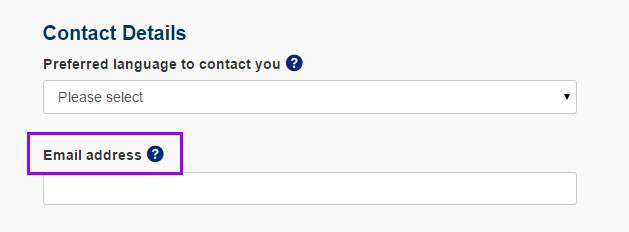
Yes. However, if you enter your email address in the Contact Details section, you will receive all emails from the Government of Canada about your client’s application. You will continue to receive these emails for the period the eTA is valid (up to 5 years).
If you enter your client’s email, the Government of Canada will email them directly.
Is the eTA linked to a client’s passport number?
Yes, the eTA is electronically linked to the passport number you enter when you apply for your client’s eTA. The person will need to travel to Canada with that passport.
Note: Your client can confirm that the passport number is correct. If it is not correct, you must complete a new application.
What happens if I entered the wrong passport number on my client’s eTA application form?
If your client reviews the approval email and confirms that the passport number is not correct, you must complete a new application.
Note: The Government of Canada will send email updates to the email address provided on the eTA application form. These emails will include the passport number that the eTA application is linked to. Be sure to confirm that the passport number in this correspondence is correct. If the passport number is not correct, you will need to submit a new eTA application with the correct passport number.
How long can a client stay in Canada with their eTA?
Normally, visitors are allowed to stay in Canada for up to six months. However, the border services officer at the Canadian port of entry will authorize the period of time your client can stay in Canada. The officer will stamp or write on your client’s passport the length of time.
- Date modified: